Friday, September 22, 2017

Barge Date:  09/09/2017

Namur

As seen in a pastry shop.
As Bruce has several days before his train ride back to the UK, he and I begin to walk the streets of Namur. As with most European cities, it has a good number of cafés and restaurants. As we look further, we think that Namur may be more interesting than we had believed. So many shops and interesting streets, churches, and places for refreshments. One evening we have to share our outdoor meal with a number of the city people nearby who would be classified in the US as homeless. We also see a good number of people panhandling throughout the city and we are told that they are busted in the morning and picked up in the evening, and they must collect money so they can pay someone for their upkeep. Perhaps a sad story.

Marianne has returned from Brussels to be on the boat until her departure back to America. The three of us decide to take the boat up the river to explore and so Bruce can do some training with Marianne at the front of the boat. Unfortunately, these locks on the Meuse River have the most stupid arrangement for bollards that I have seen thus far. You want to be able to place or throw a loop of rope around the bollard and be able to retrieve it when it is needed. So to make the process more difficult, these bollards have metal pins coming out opposite sides from each other. This may not interfere with getting your loop on the bollard but it sure makes it near impossible to flip your loop off the bollard when you need to. Added to this, there is a railing system immediately behind the bollards. So if you want to throw your rope around the bollard, it inevitably hits the railing and falls off the bollard to be retrieved so you can try again. As I have said, just a stupid arrangement. From this training, we have determined that we will get a lighter rope next year for attaching to lock bollards and use the existing ropes just for mooring. This should make the front end rope work easier for whoever is doing it.


We passed through three locks and see some evidence of a place to eat so we inch our way to a dock in a small town (Rouillon). We have seen a phone number and Marianne calls but they do not offer lunch. However we are given some information about a nice garden a short walk away that has a small restaurant. So we strike off up the hill and in 15 minutes we are at a lovely setting with manicured grounds with lots of fountains (the gardens of Annevoie) and the small restaurant we were told about.

There is not enough time to tour the gardens as we must get the boat back through the three locks before they are closed for the evening. But I am thinking this might be a good trip for when the kids are here for the wedding.

The return trip back to Namur is uneventful but of course the front deck crew must deal with the stupid bollards.

The following day, Bruce must depart by train and we thank him again for helping us out. We met some interesting people and I learned a good deal from him. We hope he finds the barge of his dream.

Now it is time for Marianne and me to discover Namur. One of the first stops is a museum dedicated to Felicien Rops. Rops was an illustrator in the 18th century and somewhat of a trouble maker. He produced some pamphlets and papers with his writing and art work but soon settled in to illustrating books for other authors. It is these pictures that we see in the small museum. Link:   https://www.museerops.be/

Marianne hears about a super large garage sale (the largest "brocante" in Belgium). Actually, it is an event that has been going on for many years and while you will see some Barbie dolls being sold, the great number of vendors are antique sellers. This event takes place in a town outside of Namur (Temploux, 8 kilometers away). We must take a bus to this location and when we arrive, the crowd is already quite large. The sales take place on the village streets which are now closed to all traffic and they extend into the countryside. Literally, there is just too much to see in one day. From soup to nuts you can find almost anything. Of course, being on a boat means that we do not want for much. But Marianne has found two small oriental rugs and a few other items. This is a two-day event and draws people from Belgium, France, Germany, Britain, and Holland, both buyers and sellers.

You can't be in Namur without climbing to the citadel. This fortress sits high on a rock bluff at the intersection of the Sambre and the Meuse rivers. While there are roads that you could take to the top, we must take the steps and path that lead to the fortress. There are many fine views of the area that can be had from this vantage point. 


By walking the streets of the town, you see things that you might not ordinarily seek to find. One is the sculpture of Bayard, the horse of Renaud de Montauban and his three brothers (the four sons of Duke Aymon). Bayard is a mythological horse and plays a role in literature of the Middle Ages. It is said that Bayard was given to Charlemagne and hence the link to Marianne’s family tree.

If it is Thursday, then you must be in Brussels. We go back for two things. First, my residence permit is now ready for me. This is great. I only have five more weeks in the country to use it. But we visit the City Hall once again to collect the document. Several weeks later, I will receive a letter from the mayor inviting me to a small soiree so I can get to know my new town.

No, that is not a beard.

I was expecting to return to the boat the next morning but I am talked into staying so that Marianne and I and the Brussels family can visit more museums in town. We travel to a museum dedicated to war paraphernalia and equipment. We had a nice lunch downtown and headed back to the in-laws home. They have just recently installed a modular chicken coop in their backyard and we are able to visit with the three hens that are now in residence. For our last meal, we are taken to a very nice Chinese restaurant where I have duck and enjoy it very much.


In the 2 books by the previous owner of our boat, Hart Massey, he talks about trying to get a good duck meal in France and never gets it until he eats at a Chinese restaurant.  The chef tells him that the French want a large duck, which is not good. The key is a younger duck. Bon appétit.

In the morning we go to the airport to launch Marianne on her return. Because of a strike of the baggage handlers there is some question about when Marianne will depart and when her bags might arrive in the US. Luck was with her and the flight was only slightly delayed (Note from Marianne: I would not call sitting in the plane on the tarmac for over three hours — after delayed boarding — and losing my connection "slightly delayed") and her bags traveled with her.

I am escorted by my brother-in-law to the basement to catch a train back to Namur. Again, thanks to our Belgian family for all the help provided this summer.

I am back on the boat and alone; there will be some time before the next crew joins me so I try to stay busy and this is not difficult given that I am on a boat. I have been dealing with a pump problem and have ordered a part that may solve the problem. I also must begin the cleanup of the oil spill made during the last oil change. I also get to do some electrical work as I have shorted out the pump and need to find how to reset it. For this, I re-read remarks made by Hart Massey when he sold the boat. He identifies which fuse or breaker controls which part of the boat. To make it easy for the next time something blows, I print out labels for all the fuses and breakers.

I have found a nice restaurant close by, run by a Croatian Albanian man. He speaks very good English and runs a very nice place. He usually begins the meal by offering something unexpected. Once it was a corn chowder. Once a new drink he was trying to create, another time fresh mozzarella and tomatoes. I return several times. It is the Le Ponti 2 Restaurant run by Gazmend.

Laundry is always on the list of something to do and even though we have a small washing machine on board, it's nice to go to a laundry to get the job done. They have instructions in English as I suspect they have a good following from the marina. Guests are coming so clean laundry is a must. Wedding bells begin.

Coming up, I will soon have family guests on board again. My Brussels niece is to be married this coming weekend and my two older children will arrive for the wedding with their significant other. So the boat must look shipshape and ready to go. I spend a good amount of time polishing and cleaning.


Saturday, September 2, 2017

Barge Date: 15-08-2017
Oil Spills, a 73-meter Lift, 3 Misfits, and Boating Friendships

After Marianne and Max departed, I had time on my hand waiting for the arrival of the Australian, Bruce.

Although it was not time to change the oil just yet, I thought it might be a good idea to go ahead and tackle this job. This DAF engine has an old style of oil filter; in place of the modern spin on/ spin off all-in-one oil filters, this engine has a replaceable filter that is housed inside a metal cylinder. This is identical to what I had on an old tractor.

Normally, you unscrew a drain plug to allow the oil in the filter to escape and be captured cleanly. This drain plug, however, was on pretty tight and I had a fear of damaging this outer housing and being in a real pickle. So, with oil still in the container, I unscrewed it from its housing. Planning ahead, I had a small plastic bag around the container but these things never really work the way you want them to. So I spilled a good bit of oil which went into the bilge and elsewhere.


I keep two oil filters in stock and I had the replacement ready to be installed. The kit includes a large O-ring that is seated in the upper housing where the top of the container is screwed in. In addition to being this old style of filter, the location is terrible. Just not much space to get everything in and out without adding to the mess. But with a little bit of finesse I assembled everything and just had to test to make sure everything was seated properly. Of course, I am now on the boat by myself, so I must be out of the engine room to start the engine. This I do and then immediately jump down into the engine room to take a look. It was leaking.

Nothing to do other than to take it apart again but now filled with new oil. It did not come apart well, and more mess accumulated. I checked the O-ring to see that it was still properly seated and worked the container back into its housing. Now for the second test. Drum roll.

This time an even bigger leak. What am I doing wrong? I know how the parts go together and although the work space is limited, I thought I had done everything correctly. What to do?

Bruce will be arriving in several days and I must be ready to move the boat. Not wanting to push my luck, I rode my bike to a Renault truck dealership. I took my DAF manuals with me and was able to get across that I was in a sinking ship and needed their help. They agreed to send a man with me back to the boat and have him install the filter. This truck garage also had another filter for this type of system and I purchased that.

It must have been the first time the mechanic had been into an boat engine room. There is not a lot of work space. He got himself situated on the floor and took apart the filter and installed a new one with a new O-ring. Everything seemed to be going well and we started the engine to test. At first, he said looks good but a short time later he said stop the engine. It was leaking for him too. I did not want this to happen, but I have to say that I felt a little vindicated.

He checked everything again and reinstalled and thankfully it held. Well, mostly. I'm still getting a few drips of oil when I run the engine, but you would not know by reading the dip stick. Now all I have is the job of cleaning up the engine room.

There is a part that can be had that would update this engine with the typical spin-on filters but I believe I have heard that there are none to be purchased. But I am looking.

Since I was staying longer in the marina in Cambrai, I had to pay an additional amount and commented to the captain that I had no electric. No problem, he said, a boat left this morning and, if you will run about 200 feet of cord, you can plug in. Well, I have that much cord so I did that immediately.

I agreed to meet Bruce in front of the city hall just a short walk from the train station. In the square in

front of the Hotel de Ville people were setting up a very large carnival. They had taken over the square and many of the intersecting streets. So while I waited for Bruce, I watched the people putting rides together. Thankfully, we will be leaving before the show begins.

Bruce arrives and we look for a place to eat and over dinner we exchange histories. Bruce is living in the endless summer: summer down south in Australia, then a trip to Europe for the summer in the north. He is working on an idea to buy a barge to be able to rent it out. He has a number of years of experience with canal barges and he just needs to find the right boat.

Our route will take us further north along the Saint Quentin Canal up towards Belgium where we will turn east to travel to Namur. We have no time table other than his return tickets to the UK. Along these canals we seem to move quickly.

With Bruce at the helm, I am able to be forward to work the ropes for the first time when we actually enter the locks. This has been something that I had to demonstrate to others but have never done so myself. I found the work interesting and it varied from lock to lock.

One of the problems canal people have is anticipating what they will find in the next lock. You hope for a repeat of the lock you were just in so you know where the bollards will be found, the spacing, and what you have to do to secure the boat. Sometimes you are lucky and everything is the same for three or four locks but then the next lock or two or three are all different. But once you have done certain lock types, you are ready for most anything that comes your way.


The gate for this lock slides in from the side suspended by cables.


Since I am late in doing these blogs, I can't remember which day things happened so I may have to make up some things. I do know that when we arrived at the first lock in Belgium, we were told we would have to wait till morning. This is a big commercial lock and the big guys have to stop too. So we are tied up with boats that are much bigger than ours. And in the morning, because they are commercial, they get to go through the lock first. So we waited perhaps two or three hours to get our chance to enter.

We make good time. Our plan is to stop in Mons at the marina overnight. The reason for the stop is that IKEA is just a short walk away and I want to finally purchase a new mattress for the single berth room. What is on it is terrible, and I know from experience. At Mons, the marina is located in a large basin. We scout the area and don't see much to our liking but pull up gently to a floating dock. Tying up and walking to the office, we see that many of the pontoons are in disrepair. Looking to find the office, we find that we are in fact locked in. We are not able to get onto land. You need a card to swipe and luckily a member lets us out. We are then told that they do not rent space to outsiders. So we head back to the boat, but of course we are stopped by the gate that now will not let us back in on the pontoons. We wait a short time and someone lets us pass.

It is a large basin and we choose to tie up on a wall that is a bit further from IKEA. We head off immediately for the store and make our purchases. Since it is late in the day, we decide to take an adult beverage and we soon milk this into a dinner. We arrive back at the boat when it is dark.

The next day is a Sunday and it is raining. We decide to find the downtown area and see what there might be there. Because it is Sunday and because it is raining a bit, there is not much activity so we look for a coffee shop. We find it – Texas. Yes, that is what it is called. Texas coffee, I guess. It turns out that the owner, who might be 50, came to Europe as a student and has found it difficult to leave. So here he is in town with what looks like a successful enterprise. But he still has his Texas drawl. We did not hear him speak French, but I'm sure it must be interesting.


Sculpture made with 2x4s.  Finger is not part of art.


After Mons, I am looking forward to a great engineering experience. This is the Grand Ascenseur de Strepy-Thieu, or just the “Strepy lift.” Canal locks can raise or lower your boat a small amount but there is a limit probably based on cost. If you have to overcome large elevation changes, it means you have to have multiple locks. Cost again. So at this location, the Belgians have built a vertical lift. Think of a bathtub hung by cables. You drive your boat into the end of the bathtub which is filled with water, of course, and they close the end. Then the bathtub is raised up. The vertical lift is 73 meters. While I took a good number of pictures, I was not terribly excited by the experience. You move so slowly that you have no feeling of being moved. When I return through this canal in September, I will take a slightly different route to use multiple incline lifts that are on the old part of the canal. Here are a lot of pictures. Need an engineer to explain.


An air shock at the top to soften the stop.


Further along this canal, we are able to join up with a flotilla of small boats which makes lock passage easier. There are a number of Belgian boats and we assume they are talking to the lock operator, so we just need to follow along.

There has been some rain today and as we approach a large canal that goes up to Brussels we begin looking for a place to tie up for the night. Nothing seems easy so we decide to stake out again.  The problem will be the sloop of the canal wall.  They are not vertical walls so our boat has nowhere to bump up against.  I tell Bruce we have 2 tires on rope in the forward hold and I pull them out. We situate them under the curve of the hull so when lines are pulled in, the boat is on the tires not the grinding sloping wall.

A Danish sailboat has been part of our travel group and he has a problem too.  He has a keel and needs deeper water when he ties up.  We suggest they tie to our boat and this gives him the depth he needs. We invite them over as they allow their dinner to cook.

About this time, a young man on a bike stops and asks about the route to Brussels.  He is wet from head to tail.  Normally he pitches a tent and hopes for the best.  I suggest he stay the night on the boat and try to dry off and warm up.  He is Dutch and starting his second year of university.  He started the trip with his brother but he was injured somehow and had to drop out. So Oliver joins us and the Danes for refreshments and good talk as we get to know everyone.

The Danes have been in the Mediterranean for the past year and we hear their stories. Oliver is a very good cyclist and races for a Spanish sponsored team but had an accident several weeks ago and has had to recover and retrain to get back in condition.


I told Oliver I would take him out to dinner since we were low on supplies.  Two very nice restaurants are noted as being nearby.  I lend him some dry clothes, socks and shoes and we head out.  Maybe it was the busy weekend, maybe all the rich boaters on hand, maybe they were stuffy high-end places or maybe it was the way we were dressed (assorted looks and mismatches) but both places said there was no room for the 3 misfits. We made the best of it back on the boat with pasta and sauce.

Oliver departed warm and dry the next morning.  We had talked late into the night and enjoyed his youthful views (did you know there is a Bible belt in Holland?). Might ask him and his brother to come on board next year for a trip.

We will be passing through the large city of Charleroi and I have been told that it is an ugly, industrial city that has seen its better days. So I am curious as to what we will see. It certainly is not the Midi Canal in France, but I have to say that I found the passage interesting and certainly not the horror stories that others like to tell. True, you are looking at the backside of this city where all the manufacturing takes place. But it was interesting to see what was going on. A lot of steel was being produced, and we could see both ends of the process. Scrap steel arriving on barges to be unloaded by huge cranes with either big claws or magnets. We also saw rolled steel and coiled steel being loaded back onto barges ready for shipment. Perhaps it is the little boy in me, but I could have watched this work for many hours.


As we left the manufacturing area, we were on a serpentine route out of town. On each side were suspended "tow paths" along the canal. Interesting. I would also note that these tow paths allow people on foot or on bikes to pass by the industrial sites that we saw. Nowhere in America would this be allowed. Too dangerous, I guess, but I didn't see a lot of dead Belgians on the towpath either.

Our flotilla continued along. In all the locks, we saw a Belgian couple having great difficulty handling their small boat. They also had the habit of entering the lock and tying on too soon thus not allowing any other boat to have easy access forward. At one point the gentleman had to leave the boat to show his papers and he exited the boat with great difficulty. We came to learn that they have only had this boat for one week. OK, give them a little slack.

Further along, one of the Belgian cruisers signaled that he had a problem. Something was wrong with his propulsion system. I don't know exactly how it works, but he thought there was something in the tunnel that leads to the propellers. Being the only large boat in the flotilla, we came alongside and tied him to our boat. He had his engine off and together we proceeded down the canal. We agreed to overnight at the next lock and once we were tied up (with stakes), the Belgian began to look for the problem. Facing engine problems can’t be fun. The problem turned out to be a large, heavy duty plastic bag being sucked into his system. He was able to extract it from inside his boat. I don't know how all that works, but he was happy that it was not something mechanical.

He and his wife were very grateful for the tow, and we developed a boating friendship. He is now retired, but was a career Belgian military man. He has been on boats for most of his life. His wife likes boating and would like to live full-time on a larger barge, but he is not yet “on board”. They insisted that once we got to Namur they wanted to take us out for a meal, which they did. It's this type of experience that I find interesting.

We traveled on with this small flotilla and arrived at the junction of the Sambre with the Meuse River. Now both of these waterways are big commercial waterways and when you come to an intersection, there are certain rights of ways to be obeyed. In this case, the Meuse River has the right of way. I asked Bruce to go forward so that we might see what could be coming. And, of course, there was a big barge moving from our port to starboard on the river and, as it turns out, was also slowing down so they could tie up on the approaching wall to our right. So you slam on the brakes and give him the right-of-way. But to our left approaches the one-week skipper and his boat. He seems to slow down and hesitate but then makes the judgment that if “I just put on full power, I can scoot in front of this huge boat”. We hold our breath. There is nothing the large barge can do. If the small boat would lose power, he might be directly in the barge's path. I am sure that the barge skipper saw this small boat, and we were all happy to see that it escaped total destruction.

The tie-up at the Namur marina is easy, and there is electric and water. The location is opposite the shore where the office is located and where smaller boats moor. This looks like a good location to stay for the next several weeks.

Bruce and I have some time to begin exploring the town and we find it quite interesting. Lots of small shops and restaurants in the downtown area. The entire town is shadowed by the towering citadel that is at the juncture of these two large waterways. What a good place to build a fort. Looking forward to climbing to the top.

Wednesday, August 30, 2017

Barge Date:  09-08-2017

Big Change In Everything

The idea now is to retrace our steps out of the Somme to head east to the Canal des Ardennes which links up to the River Meuse in Belgium. Some of this is a repeat area for us so we can travel fast and don't stay too long in any town.

Several events along the way that got the crew excited:  back on the Canal du Nord, we entered a lock and wanted to use our hook to secure to a ladder. While we were heading for the second ladder in the long lock, the lock keeper closed the doors and the water came in too soon for us.  A little concern, but with some ramming of the engine, we got the job done.

Heading into new territory on the Canal de l'Oise a l'Aisne, we found locks that have some problems, at least for us newcomers.  The poles that need to be lifted to start the proper next step (the back doors closing after we are safely tied up) are at the far end of the lock, not, as we would expect, somewhere near the middle. This means that going east, the poles are near the front of the boat (will be at the stern going west on our return).  So we need to get forward towards the front doors in order to reach them.  Problems can happen.

But also, and I don't remember the specifics, with the first lock, we are being lifted and some good number of meters, and we fail to anticipate the difficulty of removing the rope from an in-the-wall bollard and expect to be able to get it off and recovered.  The water comes in fast and we can't  remove — and soon can't even see — the loop. This is a good rope and like hell I am going to leave it behind. Then the doors open and the system expects us to leave.  Not me.  How to get the water lowered again?  I place my hand in front of the magic eye beam and it thinks we have departed and somehow the water exits and we drop down and know how to place the rope correctly this time, keeping the loop on the boat's bollard.  But the system does not want to refill and, to complicate matters, another boat approaches the lock from behind us. In fact this boat may have been the one that triggered the lowering of the water. Fortunately, it is not a commercial. We signal to them that we have a problem, push the assistance button and maybe that does it as we finally rise and escape.

There was a time when all locks had a lock house and someone living there and working the lock. There was pride in how the facilities looked.  Nowadays, many small locks are automatic and the houses are vacant.  But on this section of the canal someone has taken the effort to make things look nice again.

We are tied up for a day or two and we see again an elderly man on a paddle board going in our direction.  There is a tunnel ahead and he asks if he might hitch a ride as the water people don't want him in the tunnel on the board.  But with the upcoming bad news (see further down), we are unable to help him out.

We are beginning to hear rumbles about problems east on the French portion of the Meuse. There has been very little rainfall this year in Europe and some canals are dependent on lakes high up to feed the canals during the summer. There is little water in the French section and we receive word that we will not be able to take this route into Belgium.

There is an alternative canal but it to has problems at several locations and it is closed until 2020. Our only recourse is to head back and retrace the route we have taken from the time that Marianne came on the boat. This is a great disappointment because these canals tend to be larger and busy with commercials and Marianne doesn't like this. Also, we have seen this section and don't have any interest in seeing it again. But we have no choice and we head back. We want to be near Namur for the September wedding of our niece.

During our layover in Chauny, we arrange for fuel to be delivered to the boat. Better prices this way. The truck pulls up right beside us and pumps in 500 liters of diesel. This will get us through the year.

In the town of Jussy we pick up a new crew member. Our nephew Max will be joining us for a period of time. We want to see if we can make him into a deckhand and a barge helmsman. He picks up the work quickly and helps Marianne forward on the deck with the ropes. We stop at a number of towns we have already visited but it gives us an excuse to find a restaurant or a place for ice cream. We hope Max is enjoying himself.

Marianne's brother has told her about a French TV program on Alienor of Aquitaine, another in her old family line and the namesake of our own daughter. So while in St Quentin, we all hunker down in the salon and do a little history.  Windows are open and a marine cat has walked the deck and gives us a look through the window until we ask it to leave.

We get to go through the long tunnels again and I was able to get some interesting shots of the tug that will pull us.  Then a walk up the hill to a town museum that highlights the history of these tunnels.

Being the first boat behind the tug starts with the big iron.  Today that was us.  Five or six smaller boats behind us.  There is plenty of room in the tunnel but the tug for some reason takes the east way, up against the tow path.  OK for him and would have been OK for us, the number one boat, but he does not drop the pull chain in the middle of the waterway.  He can do this by moving an arm so that the chain is not in the middle of the tug but rather in the middle of the channel.  It took me half the trip to figure out I was not steering properly to make my passage easier because of the tug's sloppy work.
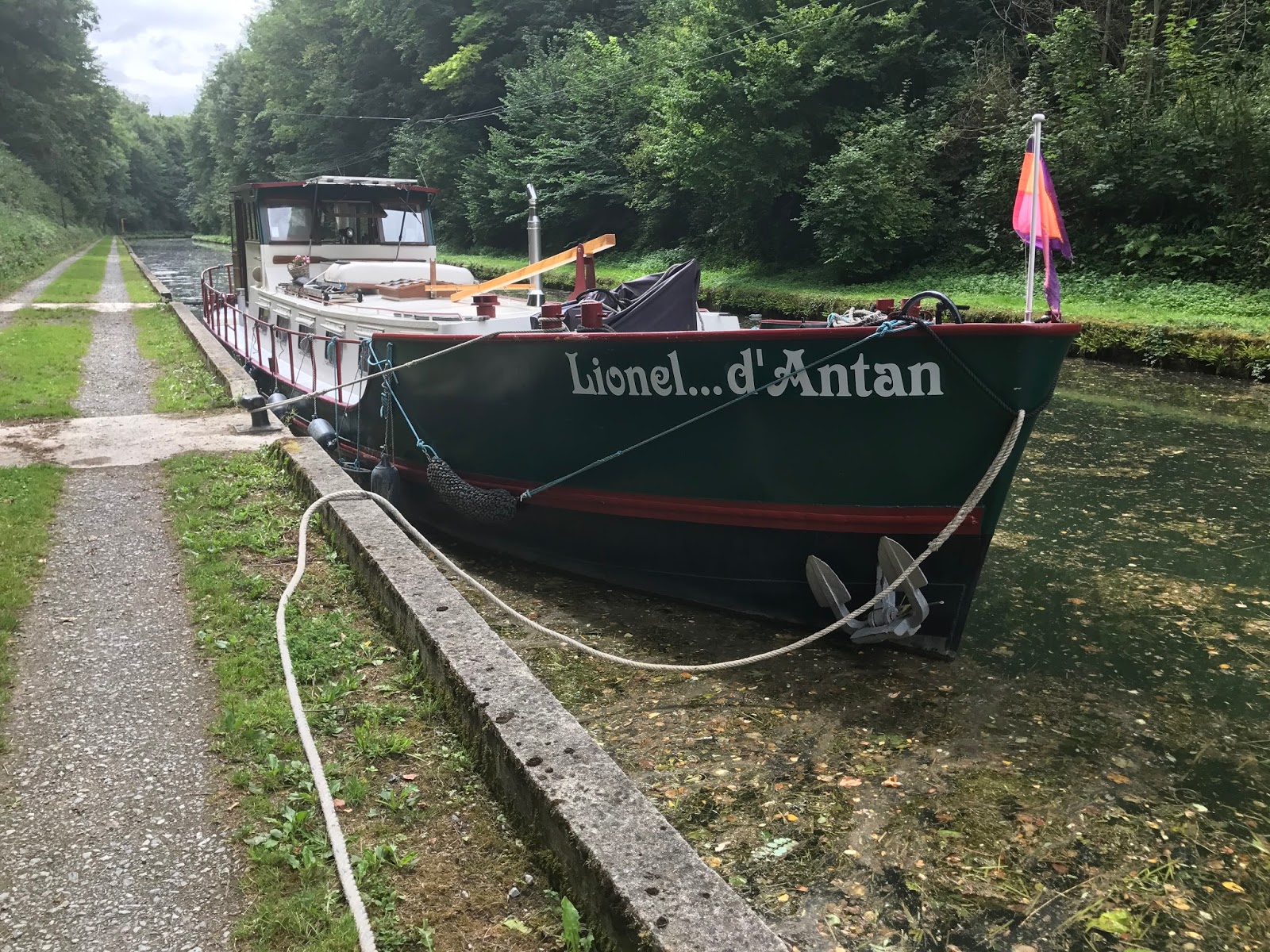
Lionel ready to be first behind tug.


On our return to Cambrai we move into the marina hoping to get electric, but all the sockets (3) are taken. They tell us that they are upgrading this marina but probably we will never be back. On the second day, a boat leaves and we grab the electric.

It is here that Max will depart and he is taking with him my number one crew mate. Marianne will be going to Brussels for a period of time and I hope to see her again before she departs for Thomasville.

Crew when not chained to oars. What is the world coming to?


Previous to this time, I had placed an ad for crew to bring the boat back from the Meuse to Diksmuide. To my surprise, I received a number of replies within the first 24 hours. Several from people that have a good bit of experience on the European canals. A couple from Australia who have been thinking hard about getting a barge in Europe responded and asked if they could have this experience to see if this is something they want to do. So I agreed to this and they will be flying north soon to meet me some time during the first week of September.

With Marianne and Max jumping ship, did I want to take the barge by myself further east through Belgium? I went back to the people that wanted to join me for the final leg of this year's adventure and I have an Australian gentleman coming over from the UK who will join me for the next week to move the boat to the area of Namur.

Bruce has been doing canal trips like this for about five years and will come aboard with a lot more experience than I. So it will be interesting and I will for the first time be able to work the ropes at the front end of the boat. I have told people how to do it, but I have never done it myself so I will see if I know what I have been talking about.


Sorry for the lack of pictures.  Marianne has lots on the FB site.  Search for "Barge Adventure".


Barge Date: 02-08-2017

Leaving the Somme


Not wanting to miss the canal that we could not see by boat, we decided to take a train to Abbeville but were interrupted with this thought when another boater said it is much nicer to go all the way to Saint-Valery-sur-Somme on the Atlantic. One must take a small gauge railroad to get there but because of a delayed train from Amiens, we got a late start. St Valery is very much a summer place for tourists. Marianne wanted to see some sites that have ties to her family that crossed a little channel to take over England. Worth a return trip and stay. There are 2 other towns connected by this small railroad that should be visited.


I would like to stay at this hotel some day.


Marianne with monument to her family's war making.


We were needed back in Brussels for my resident permit and we took the train from Amiens. The short story with the permit people is that I must again return after important papers are prepared. I have been given a secret number that will make it all work next time.

While there and being hosted once again by our wonderful Belgian family, we took a trip with Monique and Maxime to see the castle of Gaasbeek. The castle was of interest but even better for me were the gardens. The gardeners specialize in training plants and trees to be things they normally are not. Shapes, hedges, borders. People come from all over the world to learn this process. Time is a factor. This garden was started about 20 years ago and they have just opened it to the public.


Back to the boat, we began our exit from the Somme. We had been warned by the lock workers that several days earlier a car had been driven into the canal and to be careful at a particular location . We saw one very wet VW.

We were looking forward to getting back to the marina at Cappy as our new energy efficient refrigerator had arrived. The captain had stored it in his garage and we quickly retrieved it and swapped out the old for the new. While it is a bit smaller, it does seem to use less electricity. That's the point of the purchase. We also swapped out our nearly empty LP tanks so now we are filled up.

Now headed east.

Wednesday, August 9, 2017

 Barge Date: 30-07-2017

On the Somme and back again

 Forgive the formatting.  Google is the problem.


I know, some of you think that I have gone away (Mark, Guy)What is happening with the blog? I am behind again and I don't know why but let me try to catch up as quickly as I can.  This will be a bit long but you don’t want to stop too soon and miss something.

From Amiens we wanted to go east to the small village of Long. As we headed that way, we still thought that we could not get all the way to the Atlantic Ocean. So we were going to make the best of it. We had been told by a lock worker that the tie up near the lock in Long was a bit tricky but that he would be there to assist. He told us that there was space available for us (In his words, "not the best space, but not the worst either").

Along the way, we noticed several weirs in the canal with signs warning of "violent current". These are locations where excess water is taken from the canal and diverted downstream or to the lower part of the canal. Traveling past them had never been a problem. The sign before Long warned of "Danger d'aspiration" which, translated literally, means "beware of being sucked in".

In Long, there is a beautiful castle that can be viewed as you enter the town. It is just up the hill from
the canal and you can see large greenhouses filled with flowers and well landscaped gardens and lawns that come right down to the canal. Very impressive.

But just as you are passing the castle, you go under a bridge and there is a left turn in the canal that leads immediately to mooring space on the left, the lock straight ahead, and one of those sucking weirs off to your right. If we had planned it better, gone a little slower and stayed to the left bank, looked at Google Earth, and thought everything out a day before we would not have gotten sucked to the weir. As it was, I was to the right in an attempt to see around the corner and to know whether there was space. By the time I had done this, I had lost control. Apparently, this happens quite regularly at this location and perhaps it is a bit of fun for the lock workers. I don't know. But I do know that we were pulled to our starboard and up against the protective guard rail that keeps innocent barge owners from going over the falls.

I wish I could say let's go to the video but that's not possible. We attempted to back up and move to the port side but these old boats just don't want to go backwards. Finally, the lock worker who said he
was going to help us showed up.  

The only solution was to stop the water from going into the weir. This must be a simple matter because in five minutes we were able to move the boat and throw some lines to the shore where several volunteers roped us in. One of them was the owner of a boat tied up at this location. He said the same thing happened to him several days earlier and he knew it was not a pleasant experience, so he wanted to help us. A little bit of excitement for the people on the shore and maybe a little bit of learning on our part. 

Apart from the castle and a church, there is not much to the town of Long but there are some interesting stories that we find as we visit. There is a commemorative marker for a British soldier that risked his life to move a tank that was stalled on the bridge thus preventing the Allies from taking the town from the Germans. This British soldier somehow was able to get the tank off the bridge but he died while doing this. The town has this marker to remember him. 


There is a nice restaurant in this town that overlooks our mooring location and you may see it in some of the pictures. We had lunch, then ice cream, and then dinner there and it was all good. It would appear that a young couple own this restaurant and do most of the work. The lady taking our orders and seeing to all of our needs as well as many other tables was somehow able to do most everything herself. I don't know who is in the kitchen but I suspect it is just her husband. If you are in Long, we can recommend this restaurant. Its name is Le Comptoir Bleu. 

We visited the castle and it was interesting and enjoyable. I may not recall all the details but it was built in the 1700s, has gone through several owners and sat empty for 25 years. It was purchased and restored in 1964 and then bought 17 years ago by the present owner, a real estate agent, who put a lot of money into it. When he and his wife purchased it,  there was not a single flowering plant on the property. Through his work and with 4 gardeners, the place looks very nice. From the outside, the castle looks grand and large but it is a bit deceptive. 


This is a very swanky pigeon coop from the inside.


Once you are inside, you realize that from front to back there is just one room in depth. We took the tour of the castle (no pictures allowed inside unfortunately) and enjoyed seeing the results of the restoration work that has been needed to bring the rooms back to life. The castle was purchased in 2000 without a single piece of furniture, except for a piano and an automaton (piano player) that the purchasers insisted on keeping. The couple that own the estate live here but we did not see the rooms that they occupy. I particularly like the greenhouses and their location down the slope towards the canal.
  
When our visit was done, we successfully passed the weir to go through the lock so that we could make a U-turn and head back towards Amiens. We stayed one night at our regular mooring site and did some errands in town.